
Under the Shield
Sedhiou, Senegal
Follow Us on:
Follow Us on:
Contacts:
Contacts:
https://www.iubenda.com/privacy-policy/14663859
Design team: Dimitra Chatziandreou, Natasa Ferentinou, Giuseppe Vultaggio
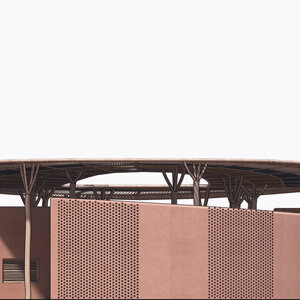
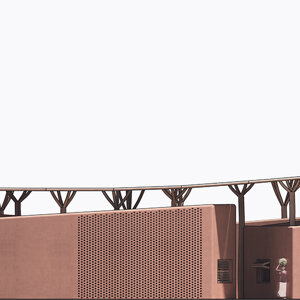
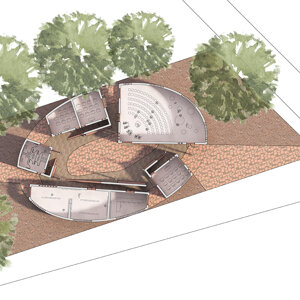
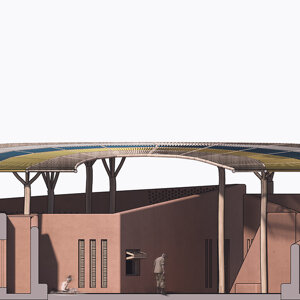
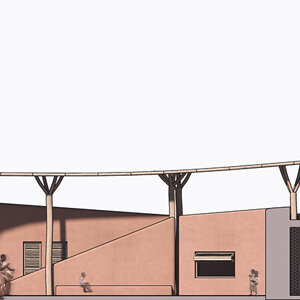
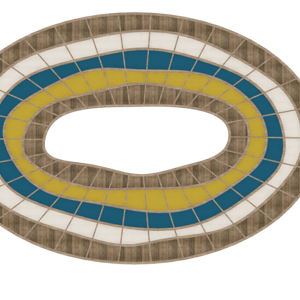
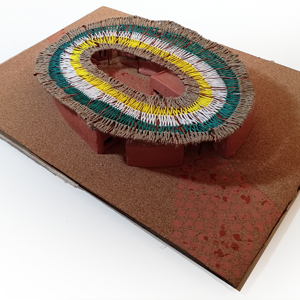
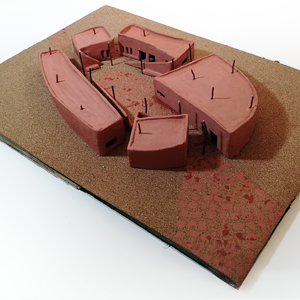
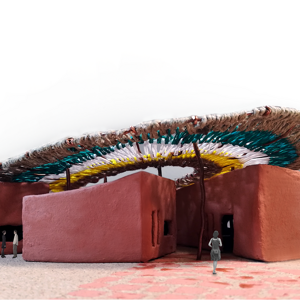
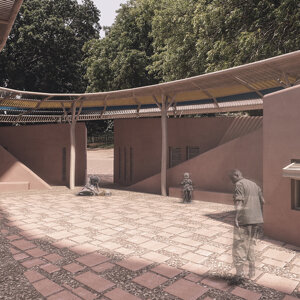
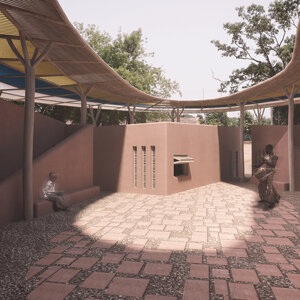
The Sedhiou cultural center consists of five volumes arranged around an interior court, imagined as fragments that were generated by the decomposition of an elliptical building. The original form is recomposed only in the canopy, taking the form of a large colored shield.
The five buildings will function respectively as one multifunctional hall for events and performances (220sqm), three rooms dedicated to education and training (132sqm), an exhibition center (110sqm), toilets (40sqm) and an office (48sq.m).
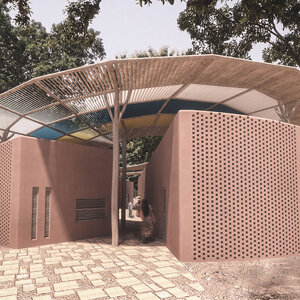
Pedestrian paths penetrate the elliptical form, creating secondary common yards attached to the main square and towards all directions. The purpose of these spaces is to attract the citizens of Sedhiou to the center of the building, so they can use the inner court as a public square.
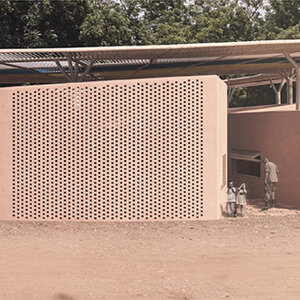
The cultural center will be built using only local materials. The buildings will be constructed with clay bricks and wooden beams, coated with natural earth-based plaster afterwards.
The walls have a thickness of 45cm in order to preserve the internal temperature as cool as possible, without the use of mechanical air - conditioning.
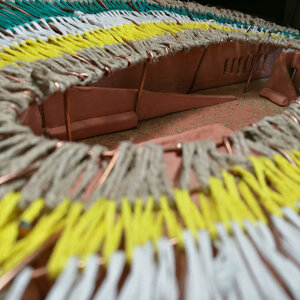
The canopy is made by colored wooden logs and slats, built on site, according to local craft techniques, while the outdoor space is made of clay, using shells as inert. In order to identify the path towards the main space, there is a number of laterite bricks inserted as seen in the master plan.
The canopy protects the building from the sun by reflecting its rays, while at the same time it allows the rainwater to pass through the wooden slats and be collected. After the water passes through the canopy, it is collected on the flat roofs and directed to underground tanks for future use inside the buildings.